Booking choice: The tour with the mausoleum, from $32 per person. Check dates Tour details
The pits lie about 1.5 km east of the emperor's tomb mound at Mount Li (Lishan), and the soldiers face east, guarding the tomb (Wikipedia). The museum numbers them in the order they were found: Pit 1 in 1974, then Pit 2 and Pit 3 in 1976.
Below: how many pits there are, each pit in turn, the bronze chariots, the colors the figures once wore, how they were made, and the route through the halls, with the smaller pits in Lishan Garden.
The quick answer
Pit 1 is the largest: 230 m long, with the main army of more than 3,000 figures. Pit 2 holds cavalry, chariots, infantry and the kneeling archer. Pit 3 is the small command post with 72 figures. Pit 4 was found empty. The bronze chariots come from a separate pit beside the tomb mound, and Lishan Garden holds more pits, all on one ticket.
How many pits are there at the Terracotta Army?
Three pits are open, numbered in the order they were found. A fourth was found empty, and the wider mausoleum holds nearly 200 more burial pits.
UNESCO counts nearly 200 accompanying pits around the tomb, with soldiers, horses, bronze chariots and weapons, across a property of 56.25 square km. The Terracotta Army is the famous group east of the tomb, and it is the part you visit first:
| Pit | Found | Size | Figures | What it holds |
|---|---|---|---|---|
| Pit 1 | March 1974 | 230 m by 62 m, 14,260 sq m | About 6,000 estimated | The main army of infantry and chariots |
| Pit 2 | April 1976 | 124 m by 98 m, about 6,000 sq m | More than 1,300 estimated | Cavalry, chariots, infantry, archers |
| Pit 3 | May 1976 | 28.8 m by 24.57 m, 520 sq m | 72 | The command post |
| Pit 4 | Excavated, empty | Not on show | None | Probably left unfinished |
The sizes and estimates are the museum's, worked out from the density of the trial digs. The museum's estimate for Pit 1 counts figures and horses still in the ground; Wikipedia gives more than 3,000 figures for the main army. Wikipedia describes Pit 4 as empty, perhaps left unfinished by its builders. Wikipedia also records that work on the mausoleum stopped when a revolt broke out late in the Qin dynasty and the workers were sent to put it down.
What is in Pit 1 of the Terracotta Army?
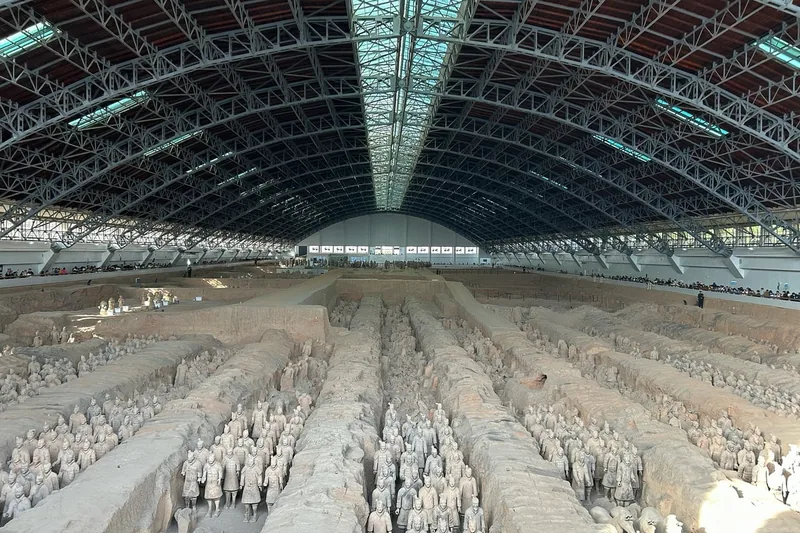
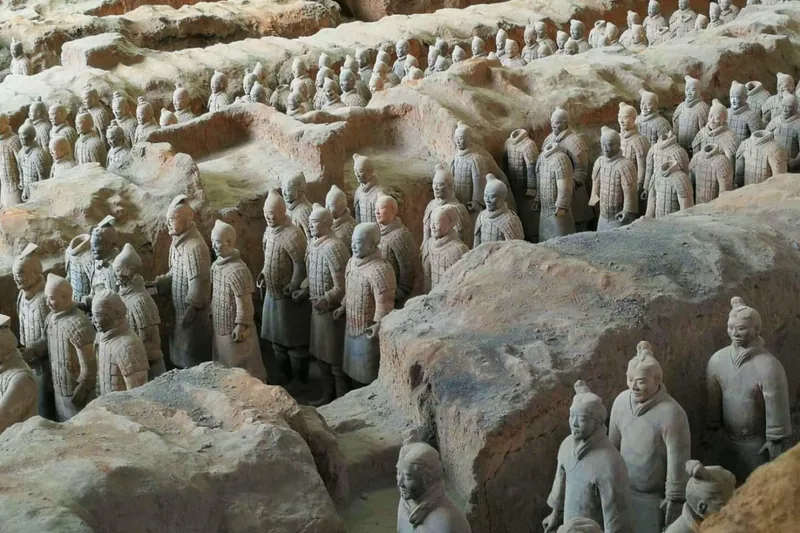
The main army: ranks of infantry and chariots in eleven long corridors, more than 3,000 figures per Wikipedia and about 6,000 estimated in all by the museum.
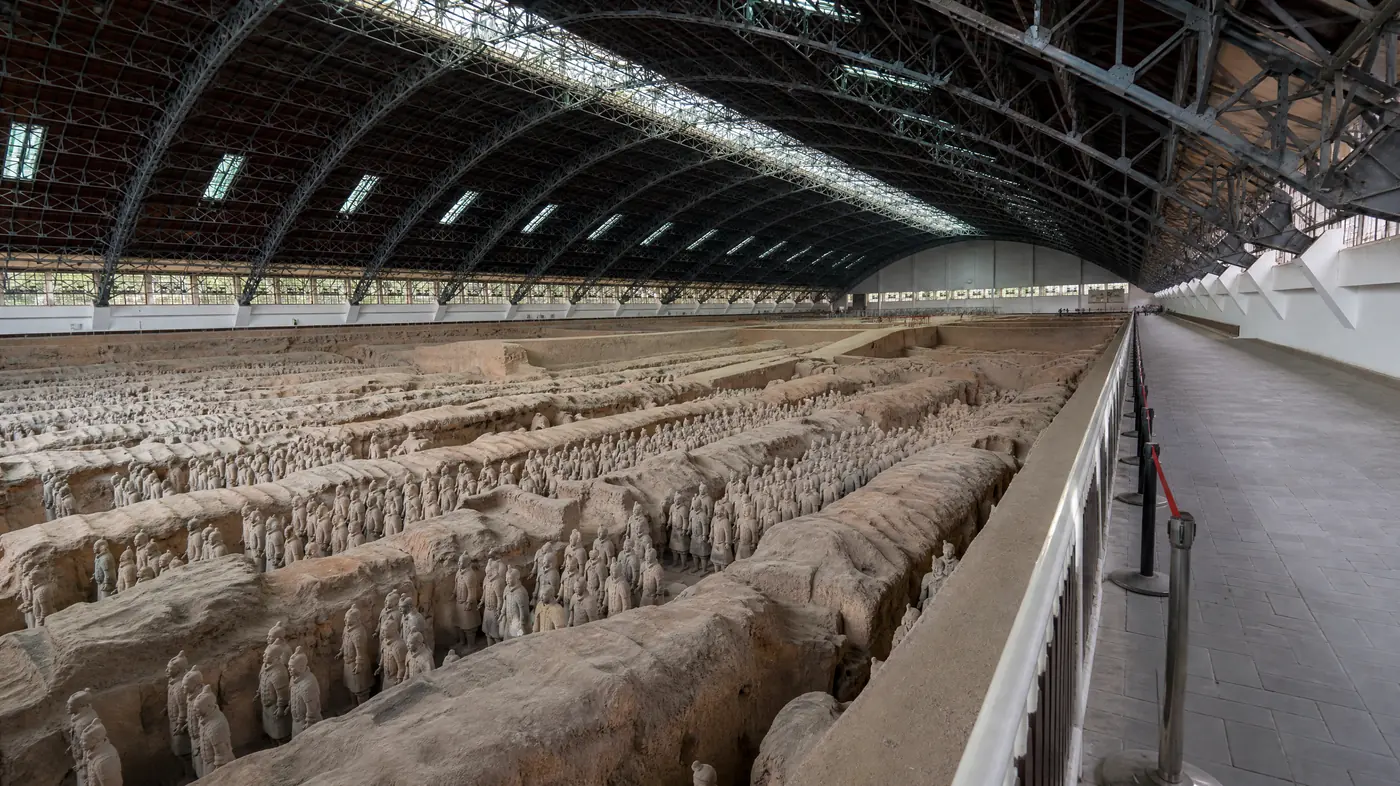
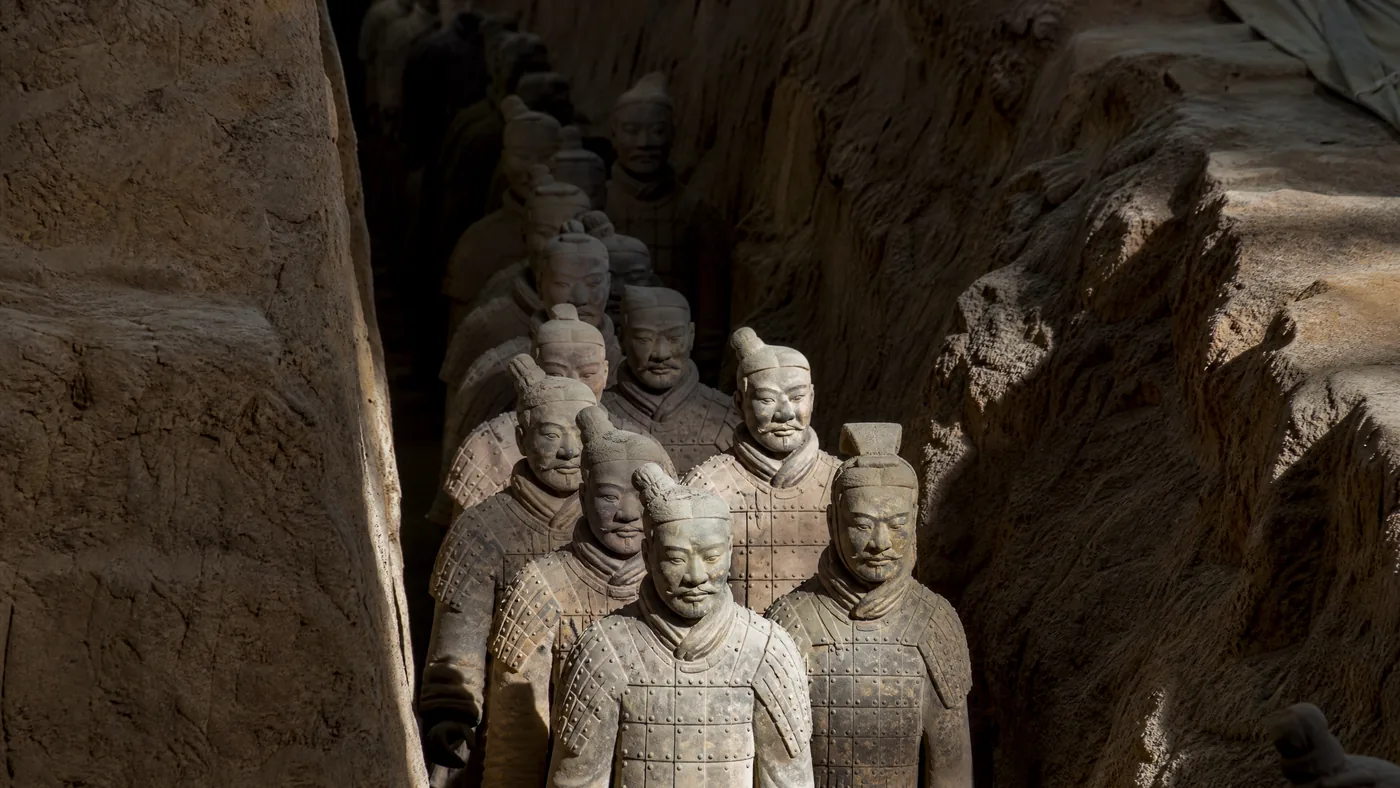
This is the hall from the photos. Pit 1 is 230 m long from east to west and 62 m wide, and lies 4.5 to 6.5 m below today's ground level, per the museum. Wikipedia describes eleven parallel corridors, most more than 3 m wide, paved with small bricks. A wooden ceiling on beams and posts once covered them, sealed with reed mats and clay.
- Facing east. The front ranks look away from the tomb, towards the lands the emperor conquered.
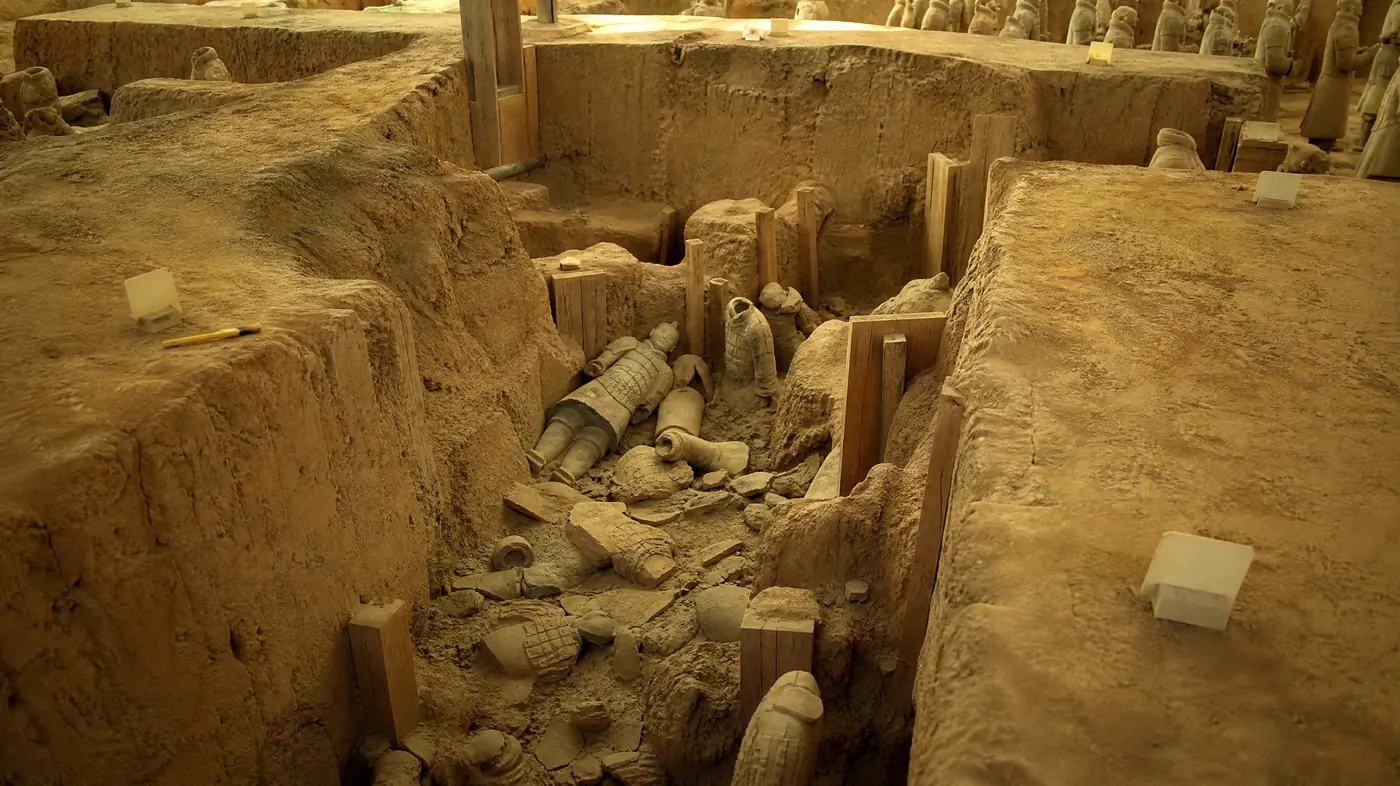
- The back of the hall. Rows of broken figures and partly reassembled warriors. The third major excavation of Pit 1 began in 2009 (Xinhua, 2023).
- The conservation lab. Opened in 2024 for the 50th year of the discovery, it lets visitors watch the repair work (Xinhua, September 2026).
Pit 1 is where a guide earns the fee. Pointing out the officers, the armored and unarmored infantry and the chariot teams turns a sea of figures into an army.
Both halves of the museum in one day: the three pits, then Lishan Garden by the free shuttle, with pickup and a guide or ticket only.
Check dates for the tour with the mausoleumWhat is in Pit 2 of the Terracotta Army?
Cavalry, chariots, infantry and archers, the most varied of the three. The museum calls it the best of the pits. The kneeling archer came from here.
Pit 2 was found in April 1976, 20 m north of the east end of Pit 1. It is L-shaped, 124 m by 98 m, about 5 m deep, and the museum estimates more than 1,300 figures and horses inside. Excavation goes on here, with a dedicated excavation and conservation facility now in use (Xinhua, 2026).
- The kneeling archer. 128 cm tall, armor over a tunic, the topknot on the right side of the head, the right knee on the ground and the hands placed as if gripping a crossbow (travelchina.org.cn).
- Cavalrymen with saddled horses, chariot drivers and chariot soldiers, all on the museum's list of Pit 2 pieces.
- New finds. In January 2026, Xinhua reported two chariots in Pit 2 buried without wheels, which the project leader thought had a symbolic role.
Take your time here. It is the pit with the most variety, and the archers reward a close look.
What is Pit 3 of the Terracotta Army?
The command post. A small pit with 72 figures and a chariot, which some scholars see as the headquarters for Pits 1 and 2.
Pit 3 was found in May 1976, 25 m north of the west end of Pit 1. It is shaped like a squared U, with a sloping entrance on the east, and measures 28.8 m by 24.57 m. The museum counts 72 figures and horses in it, and notes that some scholars see it as the command post for the other two pits, the army's headquarters.
Wikipedia describes high-ranking officers and a war chariot. It is the smallest hall and the quickest to see, and on a busy day it is often the calmest. The official route puts it straight after Pit 1, before Pit 2.
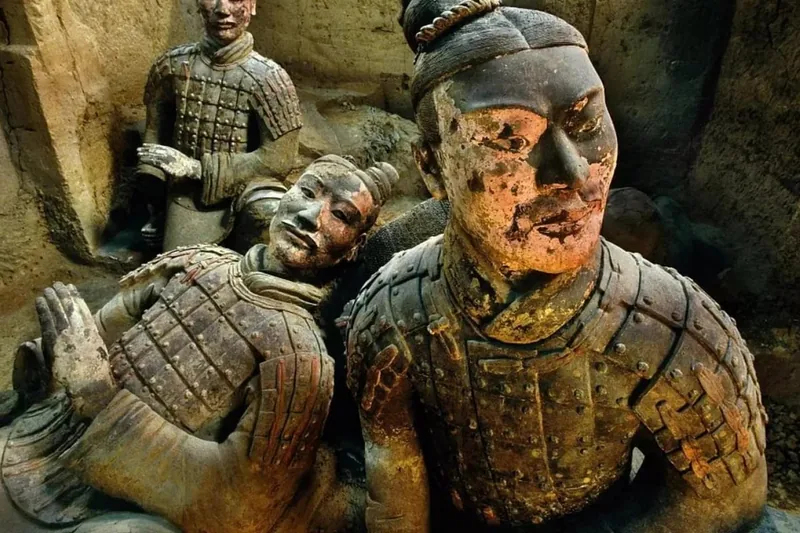
The pits and Lishan Garden, the emperor's tomb park, on one day, small-group, private or ticket only, with the free shuttle between the two sites.
Explore the tour with the mausoleum Tour detailsWhere are the bronze chariots of the Terracotta Army?
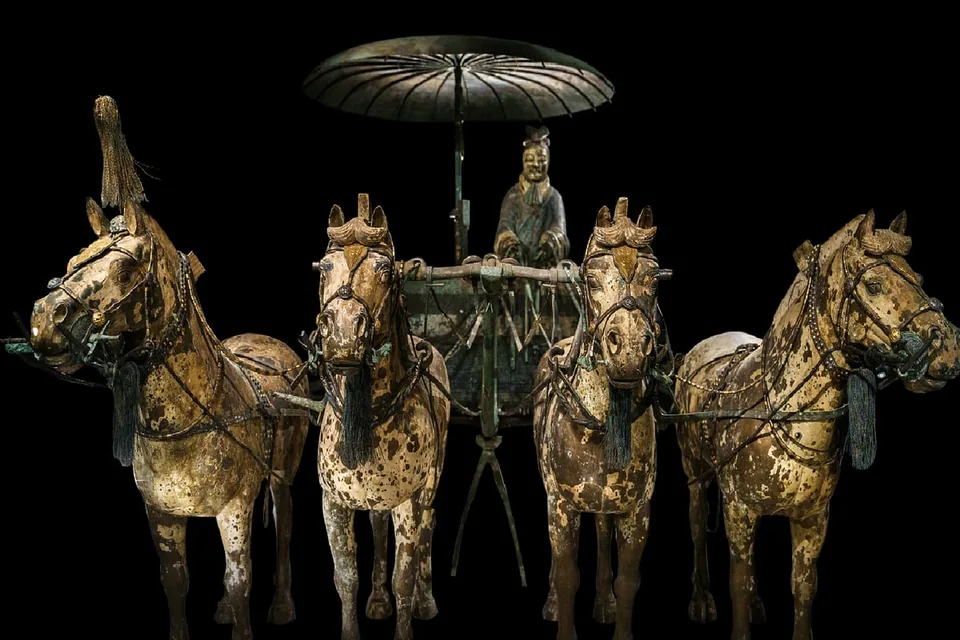
In their own exhibition hall at the museum. They were found in 1980 in a pit 20 m west of the tomb mound, not in the army pits.
In December 1980, archaeologists dug out two large painted bronze chariots 7.8 m below ground, 20 m west of the emperor's tomb mound. The wooden chamber around them had rotted and the soil above had fallen in, so both were found crushed. Nothing had been stolen, and the parts were nearly complete. The facts on the museum's page:
- Half life-size. They copy the carriages of the emperor's own procession at half scale.
- Four horses each, a single shaft and two wheels, with harness parts that keep the outer horses in line.
- Gold and silver fittings weighing 14 kg across the two carriages, a sign of their rank.
- The earliest, largest and best preserved bronze chariots found in China, per the museum.
The official tour lines on China's tourism portal end at the Bronze Chariots Exhibition Hall, after the three pits. Leave time for it.
Were the terracotta warriors painted?
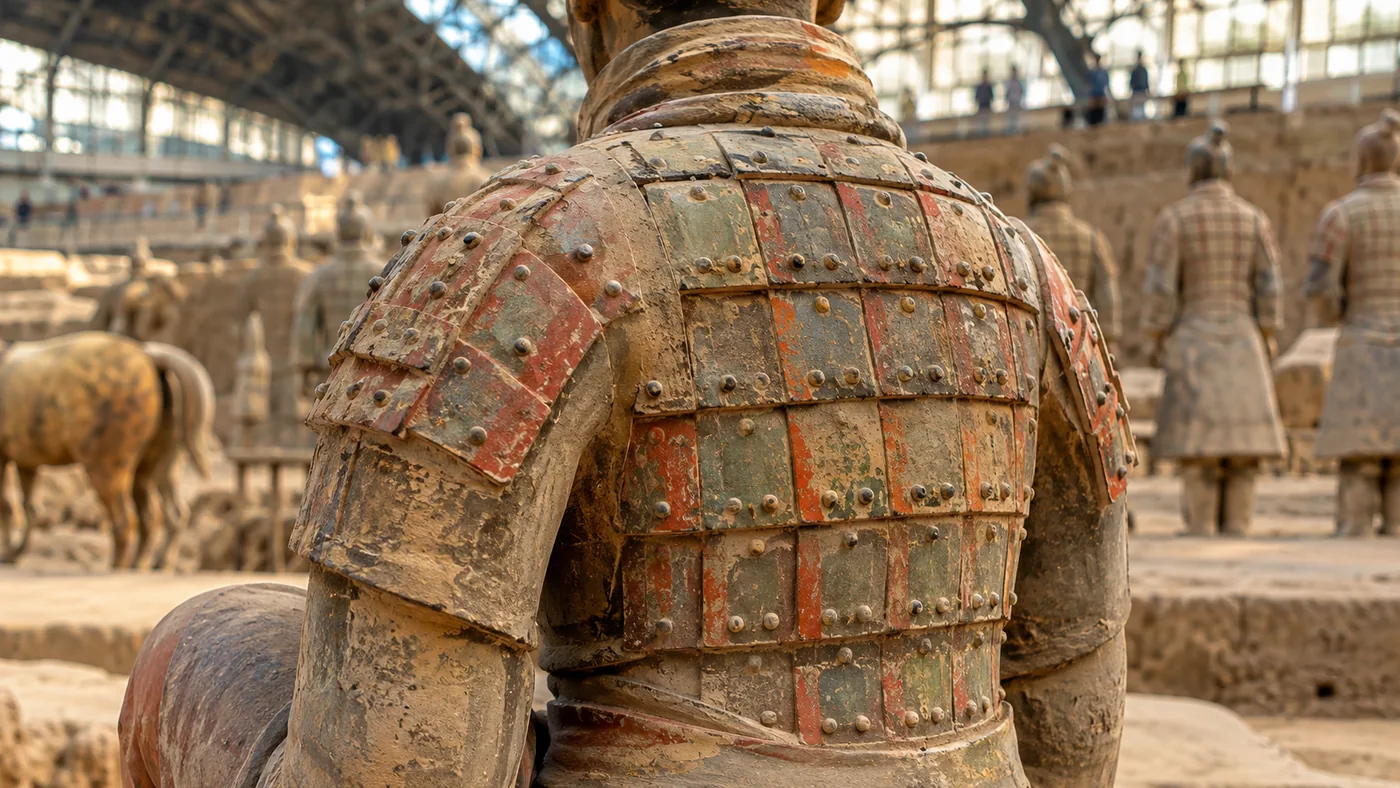
Yes. Nearly every figure was painted in bright colors over lacquer. Most of it flaked off within minutes of being exposed to the dry Xi'an air.
What you see today is grey clay. What the emperor's workers made was colorful. Wikipedia lists the pigments: cinnabar for red, malachite for green, azurite for blue, charcoal for black, fired bone for white, and Chinese purple, a barium copper silicate.
- Lost in minutes. The museum's experts told Xinhua the pigments start changing about 15 seconds after excavation, and the lacquer under the paint flakes away within four minutes.
- Some color survives. Well-kept figures still show red hair bands, pink faces, red lips and purple robes and trousers, per the same answers.
- Saved on site now. Xinhua reported in 2026 that newly found painted pieces go straight to the lab at Pit 1, where humidity control and reinforcement protect the original colors.
Wikipedia adds one reason the emperor's own tomb stays closed: the fear of losing what is inside, the way the color was lost on the first warriors.
How were the terracotta warriors made?
In workshops, in parts. Heads, arms, legs and torsos were made separately, fired and joined, then finished by hand so every face looks different.
Wikipedia describes something close to a production line. Government laborers and local craftsmen worked with local clay. The legs were probably made much like the drainage pipes of the time. The faces came from molds, at least ten of them, and clay added after assembly gave each figure its own features. Each workshop marked its name on its work, which is how historians trace who made what.
The museum's experts told Xinhua that the body came first, then the arms and legs, and last the head. Figures range from about 1.75 m to about 2 m, and rank shows in height, uniform and hairstyle.
The weapons were real. More than 40,000 bronze items have been recovered, most of them arrowheads in bundles of 100, and some swords carry inscriptions dated between 245 and 228 BC (Wikipedia).
In what order should you see the Terracotta Army pits?
Pit 1, then Pit 3, then Pit 2, then the bronze chariots. That is the museum's two-hour route. Add Lishan Garden by the free shuttle for the tomb park.
China's official tourism portal prints two routes for the Emperor Qinshihuang's Mausoleum Site Museum: a one-hour line (Pit 1, then the Bronze Chariots Exhibition Hall) and a two-hour line (Pit 1, Pit 3, Pit 2, then the bronze chariots). The museum allows about 1.5 hours for the army museum and another 1.5 hours for Lishan Garden.
| Stop | Part of the museum | Time to allow | Do not miss |
|---|---|---|---|
| Pit 1 | Terracotta Army Museum | The longest stop | The front ranks and the repair area |
| Pit 3 | Terracotta Army Museum | Short | The command post layout |
| Pit 2 | Terracotta Army Museum | Medium | The kneeling archer and the cavalry |
| Bronze Chariots Exhibition Hall | Terracotta Army Museum | Short | The gold and silver fittings |
| Lishan Garden | Mausoleum site park | About 1.5 hours | The tomb mound, the acrobats and the civil officials |
Lishan Garden is the second half of the same museum, around the tomb mound at the foot of Mount Li. The museum's pages describe its smaller pits: one of acrobats, found in 1999, with more than 20 figures and two bronze vessels, and one of civil officials, found in 2000, with 12 figures. China Daily's government page also lists a museum of stone armor in the park.
Most half-day tours cover the army museum only. The tour with the mausoleum is the one built for both halves, from $32 per person. Our timing guide has full plans by the hour.
Frequently asked questions
How many pits are at the Terracotta Army?
Three pits are on show: Pit 1, Pit 2 and Pit 3. A fourth pit was found empty, and nearly 200 more burial pits surround the emperor's tomb.
Which Terracotta Army pit is the best?
Pit 1 is the most impressive, with the main army in its long corridors. The museum calls Pit 2 the richest, with cavalry, chariots and the kneeling archer.
What is in Pit 3 of the Terracotta Army?
The command post: 72 figures and horses with a chariot, which some scholars see as the headquarters of the army in Pits 1 and 2.
Were the terracotta warriors colored?
Yes. They were painted over lacquer, and most of the paint flaked off within minutes of excavation. Some figures still show traces of red, pink and purple.
Ready to book
Choose your tour
Free cancellation up to 24 hours before on every option. Prices are from-prices in USD and move with the season.
Terracotta Army & Lishan Park, the Emperor's Mausoleum
Both halves of the museum: the pits and the tomb park
Terracotta Army Small-Group or Private Tour
- Hotel pickup and return in Xi'an
- Museum booking handled for you
- English-speaking guide
Private Terracotta Army Half-Day Tour
Your own guide or driver, your own pace